
Why Do I Keep Repeating The Same Patterns?
Why knowing better doesn't always mean doing better…
There is a super frustrating experience that happens when you become self-aware enough to recognize a pattern... and then continue to do the exact same f*cking thing anyway. You know this relationship dynamic doesn't work for you, and yet you stay. You know what happens when you say yes even though you want to say no, but you do it anyway. You know that avoiding the conversation isn't going to make the problem disappear, yet you continue to distract yourself. You know taking responsibility for everything eventually leaves you resentful, but you continue to carry the load and become bitter towards those that let you bear that weight alone. You know overthinking the decision for another three weeks probably isn't going to reveal the magical piece of information you've somehow missed, yet you pencil it into you schedule.
You know. And yet somehow, there you are… again. Same feeling. Same reaction. Same role. Different Tuesday. This is usually the point where people start getting pissed off at themselves.
Why do I keep doing this?
I know better.
I thought I dealt with this.
Why haven't I changed?
But there's a problem with that line of thinking. Knowing that you have a pattern and understanding why the pattern keeps happening are two very different things. And if you've spent years trying to change something by simply telling yourself to stop doing it, it’s time to call yourself out on your bullshit.
A PATTERN ISN'T JUST SOMETHING YOU DO REPEATEDLY…
When we talk about patterns, it's all too easy to focus on the visible behaviour. You keep choosing emotionally unavailable people and wonder why. You avoid conflicting create the conflict within instead. You procrastinate and then crumble under pressure. You overwork and then don’t create time to recover. You overexplain and then feel embarrassed for oversharing. You shut down. You people please. You leave. You stay. You try to control everything. And the list of contradictions go on.
Those are the parts we can visible see and acknowledge. But the behaviour itself is often the last step in a much larger process that the shadow has created.
Life happens. Your ego programming interprets what happened. That interpretation creates an emotional response. Something begins to feel threatened, uncertain or uncomfortable. And then you reach for the behaviour that has historically helped you manage that experience. Eventually, the entire process can happen so quickly that all you notice is the end. “I did it again.”
But shadow work asks us to rewind and reverse engineer the end goal problem. Because the problem-solving question isn't: Why do I keep doing this? It's: What happens right before I need to do this? That changes where we need look for the answers.
YOUR PATTERNS PROBABLY MAKE MORE SENSE THAN YOU THINK…
One of the biggest mistakes we make when trying to “change ourselves” is assuming that the unwanted behaviour must be irrational. Sometimes it for sure is... but more often than not, patterns continue because they accomplish something. Overpreparing might help you feel less vulnerable to uncertainty. People-pleasing can minimize the possibility of conflict. Never asking for help protects you from disappointment. Perfectionism protects you from criticism.
Maybe withdrawing from life frees you from rejection. Maybe always being useful and needed helps you feel secure in relationships. Maybe overexplaining your decisions helps you avoid the discomfort of someone judging of them. Procrastination can strategically delay the possibility of failing. None of those things mean the behaviour is still serving you well… it means there’s likely a legit reason your brain hasn't just thrown it in the garbage because you read three Instagram posts about “boundaries.”
Patterns tend to survive because, somewhere along the way, they became useful. The problem is that something can protect you from one experience while creating five new problems somewhere else.
THE DIFFERENCE BETWEEN PURPOSE AND CONSEQUENCE…
This distinction is important… imagine someone who has learned to avoid difficult conversations to protect themselves from conflict and confrontation. The consequence might be resentment, unresolved problems, poor boundaries and relationships where their needs aren't properly communicated.
Those consequences are very real. But avoiding the conversation may have a completely different purpose. Maybe conflict feels dangerous. Maybe another person's anger feels intolerable. Maybe disagreement feels like rejection. Maybe they've learned that maintaining harmony even though you may be dying inside is how relationships remain happy and secure.
If they only focus on the consequences, the solution seems obvious: I need to speak up. And technically? Yes, you probably should. But knowing what you should do doesn't automatically remove the thing that made doing it difficult in the first place. That's why behavioural advice can sometimes feel absolutely useless.
Set the boundary.
Have the conversation.
Stop caring what people think.
Just let go.
Cool. Easier said than done. How, exactly, would you like the part of me that believes this behaviour is protecting something important to respond to that memo? Change becomes a lot easier to understand when we stop treating the pattern like the enemy and start asking what job it’s been doing.
FAMILIAR DOESN'T ALWAYS MEAN GOOD…
There's another reason patterns can be difficult to interrupt: familiarity. Humans don't only repeat what feels good. We repeat what we know how to navigate. The ego has one mission: to keep you alive. The best way to do that, is to keep you operating in what is comfortable and familiar.
A familiar dynamic comes with instructions. You know who you are inside it. You know what role to play. You know what to expect because you know what happens next. Even when you hate the outcome, there can be a strange kind of predictability in knowing the script. Something unfamiliar may be the healthier option and still feel way less comfortable just because you haven't learned how to exist inside it yet.
Someone who is used to earning connection through being useful may feel deeply uncomfortable in a relationship where they're valued without having to constantly be doing something to earn it. Someone who has built their identity around independence may genuinely want the support from others and then feel very exposed, weak, and guilty when someone actually provides it. Someone who is used to chaos may say they desperately want peace and stability… and then be bored AF when they finally get it.
That doesn't mean they secretly want to suffer… it just means familiarity and safety can become psychologically intertwined. Sometimes the old pattern feels easier… not because it's better, but because you already know how to survive it - as uncomfortable as it may be.
SOMETIMES THE PATTERN IS A ROLE…
Not every repeating pattern looks like a habit. Sometimes it's an identity. Maybe you’re known as… The strong one. The responsible one. The fixer. The peacekeeper. The person who doesn't need anybody. The one everyone comes to. The easygoing one. The one who always has it together.
Whether you actually feel authentic in the role or not - you obviously play it well enough for others to know you as that. Roles can provide belonging, predictability and identity. They can also become super difficult to contradict. Eventually changing the behaviour doesn't just mean doing something differently… it actually requires you to become someone different.
If you're always “the capable one,” asking for help may feel like you’re a complete and utter failure. It may feel like violating who you are. If you're the person everyone relies on, becoming less available might create a much more uncomfortable question: Who am I in this relationship if I'm not needed? If you're “the peacekeeper,” allowing someone to be upset with you may challenge the entire strategy you've used to maintain connection within your relationships.
Sometimes the pattern isn't just protecting you from an uncomfortable experience. It's protecting the identity you've built around avoiding it.
THIS IS WHY SELF-AWARENESS CAN FEEL SO F*CKING ANNOYING…
Once you recognize a pattern, you expect that the very acknowledgement and awareness of it will change it. Sometimes it does, but most often it doesn't. And then you end up in the deeply irritating position of watching yourself do something you now understand you shouldn’t do anymore.
Welcome to self-awareness. 😂
But this isn't evidence that the work isn't working… recognition is the step that comes before interruption. At first, you notice the pattern afterward. “Shit… I did it again.” Eventually, you notice as it's happening, in real-time. “Omg. I'm doing it again right now!”
Then… maybe you start recognizing the moment immediately before it happens. “I'm about to do the thing again.” And somewhere in that process, a tiny bit of space begins to appear. Not necessarily enough space to make a completely different choice every time… but enough to realize there is a choice.
That's huge. That’s the moment you interrupt the pattern. That’s the moment you get to pause and hold space and ask yourself “I know better… Am I actually going to choose to do better?” And the answer will probably be No. It takes time to do things differently. You might have to find yourself in that space or pause a hundred times before you’re actually going to choose to do things differently… and that’s okay. You’ll make the change when you’re sick of your own damn shit.
Automatic patterns survive partly by being automatic, and partly by being comfortable and familiar. When you finally get used to the awkward space in the exact moment you can see the operating system functioning in real time, it isn't quite as uncomfortable as it used to be. That’s when you’ll choose to do things differently.
WHY “I SHOULD KNOW BETTER” DOESN'T HELP…
Knowing better is useful when the problem is lack of information. If you don't know how to create a budget, learning how to create one helps. If you don't know how to communicate a boundary, learning the language can help. But many repeating patterns aren't information problems. You already know. That's why lecturing yourself usually doesn't work. The constant badgering you do:
I should stop doing this.
I shouldn't care.
I need to be more confident.
I need better boundaries.
I need to let go.
Those statements describe the desired outcome, but they don't explain the existing behaviour. And then the shame of knowing better and not better makes this even harder because it shifts the question from: What is happening here? to: What the f*ck is wrong with me? One produces information… the other produces judgment. If you genuinely want to understand a pattern, curiosity will get you a lot further in that discovery than self-disgust ever will.
START LOOKING FOR THE PATTERN UNDER THE PATTERN…
This is where things get intense and interesting. Several behaviours that look completely unrelated may actually be accomplishing the same thing. Imagine someone who:
avoids asking for help,
hates being misunderstood,
overprepares for everything,
becomes defensive when their competence is questioned,
and struggles to delegate.
Those might look like five separate issues, but underneath all five could be a common thread… like: I need to know that I can handle things myself. Or: Being seen as incapable feels threatening.
Now we're not looking at five random behaviours anymore. We're looking at one larger pattern expressing itself in five different ways. Someone else might:
say yes when they mean no,
overexplain decisions,
avoid disagreement,
become highly distressed by criticism,
and constantly monitor other people's moods.
Again, five behaviours… possibly one underlying concern: Other people's approval feels connected to my sense of security.
This is why looking for the connection among your patterns across your lifetime matters. Patterns rarely introduce themselves by saying: “Hello. I am your fear of rejection and I will be influencing today's meeting.” They show up disguised as the behaviour.
HOW TO BEGIN INTERRUPTING A PATTERN…
You don’t need to completely understand where a pattern originated before you can begin working with it (although spoiler alert: it likely stems from your childhood). And you don't need to immediately force yourself into the opposite behaviour either. If you always say yes, the solution isn't necessarily waking up tomorrow and saying no to everyone like you've suddenly become the Master of boundaries.
Start smaller.
When you notice the pattern, ask: What just happened? What activated me? What am I feeling? What am I about to do? What do I believe doing that will accomplish? What am I afraid might happen if I don't?
That last question can be super useful. Because sometimes the clearest way to understand why you're doing something is to imagine not doing it.
If you didn't explain yourself, what would you have to tolerate?
If you didn't fix the problem, what would you have to feel?
If you didn't overprepare, what uncertainty would remain?
If you didn't say yes, whose disappointment would you have to face?
If you didn't withdraw, what vulnerability would you have to stay present with?
Now you're getting closer to the actual work. And it’s not fun, nor is it easy. To be on this healing journey is to voluntarily walk into the darkest parts of your being and start open the door to see what’s been hidden away. That takes a level of bravery and commitment most people don’t have. You have to be okay with not being okay. Because ripping the proverbial bandaid off of these wounds are likely going to make you bleed again before they ever get a real chance at healing.
A SMALL EXPERIMENT…
The next time you recognize a familiar pattern beginning, don't immediately try to stop it. Just create a pause. Even if it’s only thirty seconds. And then ask yourself: What does this behaviour seem to be trying to do for me right now? Then: Do I actually need it to do that for me this time?
Maybe the answer is yes. That's allowed. Maybe you aren't ready to respond differently. That’s okay. Maybe the situation genuinely requires a strategy. So come up with one. Maybe you just notice what happened and move on. So move on. But sometimes the answer will be: Actually... no. And that’s where a different choice becomes possible.
Not because you've finally defeated the “terrible” part of yourself that keeps screwing everything up… but because you've understood the pattern well enough to recognize when you no longer need to automatically follow it. That’s when change is born.
THE GOAL ISN'T TO NEVER REPEAT YOURSELF AGAIN…
You’re going to repeat patterns… it’s a huge part of being human. You’re going to recognize something, work on it, think you've moved past it and then watch it stroll back into your life wearing a slightly different outfit. Again… all a part of being human. Progress isn't: I never do this anymore. Sometimes progress is:
I noticed it faster.
I recovered sooner.
I didn't take it as far as I normally do.
I understood what was happening.
I made a different choice one time.
I stopped blaming myself long enough to get curious.
And eventually, enough small interruptions can change what once felt automatic. And not because you became a completely different person overnight or over the hundreds of time you sat in that weird space of noticing yourself about to do the thing before you did it… but because you became more conscious of what had been making decisions on your behalf and got sick of not being in control of your programming.
WANT TO SEE WHAT'S UNDERNEATH YOUR PATTERNS?
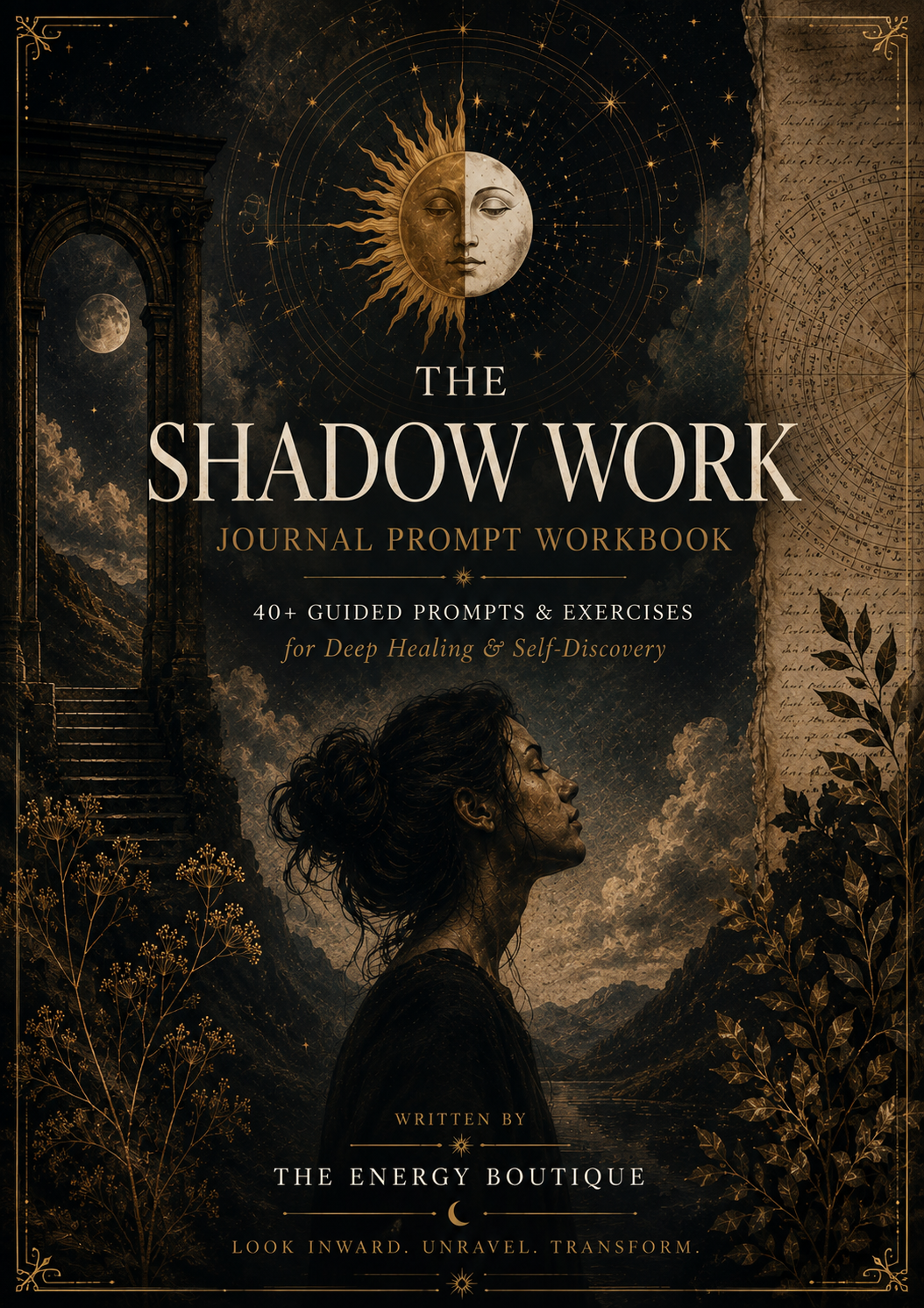
If reading this triggered something in you and brought a few things to your mind, you don't have to figure them all out at once.
The Shadow Work Self-Discovery Guide takes you through 60 pages of guided prompts across repeating patterns, emotional triggers, the parts of yourself you hide, approval and people pleasing, control and uncertainty, judgment, fear and avoidance before helping you bring what you've uncovered together into your own Personal Pattern Map. It's a structured way to stop staring at individual behaviours and start seeing the connections between them.